
English 
T: +86-139-2641-8287
No.51, Chuangye Road, Taiping Town, Conghua District, Guangzhou City, Guangdong Province, China


Views: 0 Author: Site Editor Publish Time: 2026-07-07 Origin: Site


Urban spaces, commercial properties, and modern residential designs often lack viable in-ground planting space. They frequently suffer from poor native soil quality. Integrating greenery into concrete jungles or constrained interiors poses significant logistical hurdles. Native environments rarely cooperate. This makes traditional landscaping nearly impossible. Purpose-built Garden Planters provide a modular, scalable solution. They allow you to integrate greenery smoothly. You can control soil environments completely. They also elevate architectural aesthetics across various properties.
This article provides a transparent, criteria-based breakdown. We will explore the functional, environmental, and design benefits of deploying these assets. You will learn how to evaluate interior and exterior applications. Ultimately, we will guide your final material and placement decisions.
Environmental Control: Garden planters isolate root systems, allowing for customized soil composites and precise moisture management regardless of native site conditions.
Spatial Flexibility: Planters function as scalable, non-permanent architectural elements for traffic flow, privacy zoning, and aesthetic focal points.
Material Specificity: Indoor and outdoor environments require distinct evaluation criteria—indoor prioritizes weight and watertightness, while outdoor demands UV stability and freeze-thaw durability.
Biophilic ROI: Strategic placement of indoor and outdoor planters correlates with verifiable improvements in air quality, acoustic dampening, and occupant well-being.
Native soil often presents severe hurdles. Think of heavy clay layers. Consider high salinity areas near coastlines. Contaminated urban grounds complicate planting significantly. By using robust Garden Planters, you eliminate soil remediation costs entirely. You completely bypass toxic or infertile ground. We simply introduce a perfect, custom soil composite into the vessel. This guarantees ideal pH levels immediately. It ensures optimal nutrient availability from day one.
Pest management becomes highly efficient. Elevated barriers reduce plant susceptibility to ground-dwelling pests. Crawling insects find it much harder to reach elevated foliage. Furthermore, soil-borne pathogens struggle to cross physical container walls. Your plants remain safer. You isolate healthy soil from surrounding diseased ground. This containment strategy represents a fundamental agronomic best practice.
Architectural zoning stands out as a primary success criterion. Large-scale modular barriers define outdoor patios beautifully. They guide foot traffic in commercial spaces perfectly. You can create intimate privacy screens effortlessly. You achieve all this minus permanent construction. Hardscaping requires permits and heavy labor. Containerized barriers only require strategic placement. They soften harsh architectural lines instantly.
Scalability matters deeply for modern properties. You gain the ability to phase installations carefully. Budgets often dictate step-by-step landscaping. You can easily relocate these assets during future property redesigns. Seasonal shifts require adaptable landscapes. You might move delicate plants indoors before winter. Modular containers provide exactly this critical flexibility.
Best Practice: Always test ambient light levels in your newly zoned areas before selecting permanent botanical specimens.
Common Mistake: Failing to secure tall, narrow containers in high-traffic zones creates dangerous tipping hazards.
Air quality matters intensely in closed offices. Indoor foliage absorbs harmful VOCs efficiently. Organizations introduce air-purifying plant species into controlled HVAC environments continuously. This reduces indoor air pollution significantly. It improves occupant productivity and general mood. Well-documented industry frameworks validate this biophilic approach. Greenery transforms sterile spaces into vibrant environments.
Open-concept offices often suffer from severe noise pollution. Large residential living areas echo uncomfortably. You can use tall, densely planted indoor containers to break up sound waves. Strategic foliage placement absorbs ambient noise naturally. Leaves scatter high-frequency sounds efficiently. Soil mass deadens low-frequency vibrations effectively. This creates a quieter, more focused interior atmosphere.
Micro-climate control becomes much easier indoors. You can regulate ambient temperature effortlessly. Humidity adjustments remain highly localized. Exotic or high-maintenance plant species thrive here. You protect delicate tropicals from harsh seasonal winds. You maintain perfect moisture levels for demanding orchids. Indoor containment gives you absolute environmental authority.
Implementation reality requires extreme caution. Indoor deployment demands strict attention to watertight integrity. You must prioritize leak-proof designs immediately. Sub-irrigation systems are critical for maintenance efficiency. Floor-load capacities dictate your sizing limits heavily. You must prevent structural damage at all costs. Water damage ruins interior floors fast. Always calculate total wet weight before finalizing large installations.
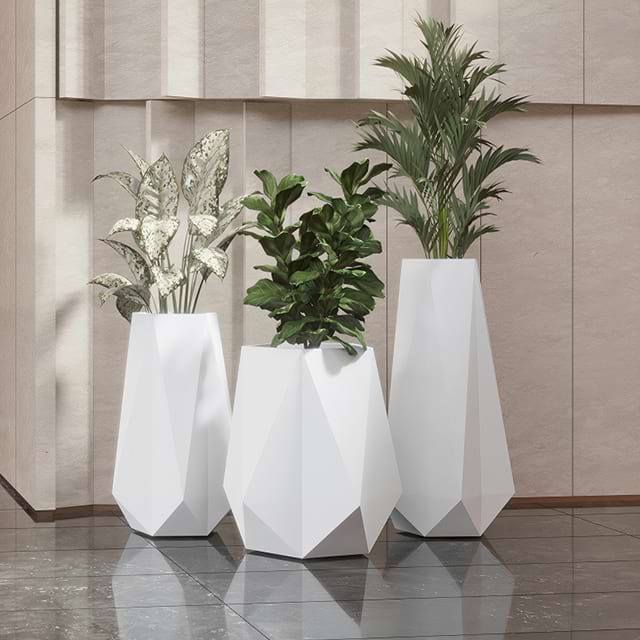
Raised containers warm up faster in the spring than ground soil. This extends your growing seasons beautifully. You enjoy earlier planting windows every year. Seasonal yield increases noticeably for edible gardens. The elevated sun exposure heats the soil mass efficiently. You gain weeks of extra growing time compared to traditional ground beds.
Heavy rainfall destroys manicured landscape beds quickly. Containers hold soil structures securely. This prevents landscape erosion during violent storms. Runoff control is a major landscape architecture standard today. By trapping soil and water, you protect surrounding hardscapes. You prevent muddy water from staining pristine concrete pathways. It keeps exterior spaces looking sharp.
Accessibility improves dramatically. Elevated planting surfaces reduce physical strain immensely. Maintenance staff appreciate the ergonomic height. Homeowners avoid deep bending and knee pain. This aligns perfectly with universal design principles. Accessible gardens invite wider participation. Everyone can enjoy gardening without severe physical limitations.
Outdoor success requires proper drainage engineering. You must prevent root rot at all costs. Trapped rainwater drowns plant roots rapidly. Robust anchoring strategies matter greatly outdoors. High-wind events tip unsecured containers over easily. You need appropriate weighting strategies at the base. We recommend heavy structural foam or coarse gravel layers.
Choosing the right material dictates long-term success. Every environment applies unique stressors to exterior and interior vessels. The chart below breaks down the core characteristics of popular materials. It helps you match material strengths to your specific environmental demands.
Material Category | Pros | Cons | Ideal Application |
|---|---|---|---|
Fiberglass & Resin | High strength-to-weight ratio, UV resistant, frost-proof. | Higher initial cost; needs pro finishes to stop fading. | Indoor/outdoor continuity, balconies, modern commercial. |
Concrete & Cast Stone | Exceptional durability, high theft-deterrence, wind resistant. | Strict floor-load limits indoors; cracks if moisture freezes. | Ground-level streetscapes, public parks, windy plazas. |
Wood & Corten Steel | Natural aesthetic integration, unique architectural themes. | Wood rots; Corten rust stains adjacent hardscapes if unsealed. | Rustic patios, industrial lofts, custom garden beds. |
Fiberglass provides a brilliant high strength-to-weight ratio. They are inherently UV resistant and frost-proof. This makes them ideal for structural indoor and outdoor continuity. They move easily across properties. However, they carry a higher initial cost. They also require professional-grade automotive finishes to prevent long-term sun fading.
Concrete delivers exceptional durability. Its massive weight provides high theft-deterrence in public spaces. It boasts incredible high wind resistance. Unfortunately, it presents significant floor-load limitations for indoor or balcony use. It also remains susceptible to cracking if trapped moisture freezes inside microscopic hairline fissures during winter.
Wood and Corten steel offer natural aesthetic integration. They are excellent for specific architectural themes like rustic or industrial. They blend beautifully into natural landscapes. Conversely, wood requires ongoing rot-prevention maintenance continuously. Corten rust runoff will stain adjacent hardscapes permanently if not sealed or channeled properly.
Drainage represents the single highest point of failure. You must evaluate the necessity of drainage holes carefully. Open drainage is strictly mandatory for outdoors. Rainwater needs an immediate escape route. Conversely, self-watering or sub-irrigation inserts remain ideal for indoors. They protect your floors completely. They also reduce interior watering frequency significantly.
You must size the vessel for mature root systems. Sizing just for immediate aesthetics is a classic mistake. You need adequate volumetric capacity. This prevents root girdling as the plant ages. Girdling chokes the plant slowly over time.
Identify the mature spread of your selected plant species carefully.
Calculate the required cubic volume for unhindered root expansion.
Add a twenty percent buffer to accommodate sub-irrigation hardware internally.
Select a container shape supporting deeper taproots or wider shallow roots accordingly.
Outdoor roots face severe thermal fluctuation risks. Above-ground containers expose root balls to faster temperature swings than in-ground planting. Ground soil insulates roots naturally. Elevated vessels lack this infinite earthen buffer. Acknowledging this requires action. You need adequate wall thickness for protection. Sometimes, you must add internal insulation panels for ultimate winter survival.
Begin by auditing your target space thoroughly. Map out daily light exposure hours. Check structural engineering documents for floor weight limits. Research historical winter temperature lows for your specific zone. You must filter your material choices through these realities before finalizing aesthetics. This logical sequence prevents costly failures. It guarantees long-term botanical success.
We transition greenery from a simple landscaping afterthought into a highly controllable design asset. Purpose-built vessels elevate spaces dramatically. They solve complex soil and spatial problems effortlessly.
Your final decision framework must prioritize functionality. Always favor material durability and drainage mechanisms over initial cost savings. This ensures positive long-term plant health and structural safety. Focus on matching the right material to your specific environmental stressors.
Browse our specification sheets and detailed material comparison guides today. Match the exact aesthetic and functional requirements to your specific residential or commercial project parameters easily.
A: Outdoor planters are engineered for UV stability, freeze-thaw resistance, and robust drainage. They endure harsh weather constantly. Indoor planters prioritize lightweight materials, leak-proof designs, and aesthetic finishes. They often utilize drop-in nursery pots or sub-irrigation to protect interior flooring from water damage.
A: Direct potting requires drainage, which necessitates a waterproof saucer to protect floors. Alternatively, keeping the plant in its nursery pot (the cachepot method) or using a sub-irrigation system allows you to use hole-less planters safely indoors without risking root rot.
A: Select frost-resistant materials like fiberglass or high-density polyethylene. Ensure all drainage holes remain completely unblocked before freezing temperatures hit. Elevate the planter slightly on discrete feet to prevent ice bridging with the frozen ground beneath.
A: It depends entirely on the material and substrate. Concrete and wet soil can easily exceed structural limits. Lightweight fiberglass planters paired with structural foam filler at the base, instead of 100% wet soil, significantly mitigate weight compliance risks.


