
English 
T: +86-139-2641-8287
No.51, Chuangye Road, Taiping Town, Conghua District, Guangzhou City, Guangdong Province, China


Views: 0 Author: Site Editor Publish Time: 2026-04-17 Origin: Site


A planter only deserves a place in a commercial interior if it still performs well after the first impression. The best Indoor Planters are not simply the boldest shapes or the most decorative pieces in a catalog. They are the options that suit the zone, handle daily traffic, support maintenance, and still look right months later. That is the standard Rovis understands through years of composite material development and production for commercial applications. In lobbies, offices, and retail spaces, “top” should always mean practical, durable, and appropriate for the setting.
A commercial planter belongs on a top list only if it works well in real use. That means it should be durable enough for public interiors, easy to maintain, safe for indoor water control, flexible enough for different layouts, and visually suitable for the space. The best planter is not the one with the most dramatic shape. It is the one that solves a real spatial need and keeps doing so over time.
This matters because commercial interiors do not stay fixed. Furniture moves, traffic patterns change, maintenance routines evolve, and some spaces are refreshed seasonally. A planter that looks impressive but is hard to move, clean, or manage around indoor flooring will not feel like a top choice for long. The more useful way to compare planters is to ask where they work best and what they do best.
Planter Type | Best For | Main Advantage | Watch-Out Point |
Tall rectangular planter | Entrances, corridors, dividers | Directs movement and defines edges | Needs the right width for circulation |
Cube planter | Corners, elevator banks, waiting spots | Balanced footprint and easy placement | Can feel too heavy visually if oversized |
Round planter | Lounges, reception areas, hospitality zones | Softer look and more relaxed atmosphere | Needs enough surrounding space |
Modular planter | Open offices, branded layouts, dividers | Flexible arrangement and repeatable order | Requires good layout planning |
Tabletop planter | Reception desks, shelves, display counters | Adds detail without taking over the area | Must stay scaled to the surface |
Statement planter | Hotel entries, showrooms, feature zones | Creates strong first impression | Should remain manageable despite size |
Tall rectangular planters are one of the strongest options for spaces that need structure. They help direct movement, define edges, and divide open interiors without building hard barriers. That makes them especially useful in lobbies, corridors, retail walkways, and open-plan offices where the space needs organization but still has to remain visually open.
Their strength comes from the clean lines they create. A row of tall rectangular planters can guide people naturally through an entrance or along a circulation path. They can mark the edge of a seating zone or create a softer separation between a waiting area and a passageway. Unlike fixed walls or bulky dividers, they provide structure without making the room feel closed.
They also suit modern commercial interiors because the form looks clear and intentional. In hotel lobbies, they help frame arrival areas. In offices, they divide open workspaces while keeping visibility. In retail, they shape customer movement without reducing openness.
Cube planters are among the most practical commercial options because they are easy to place and visually balanced. Their footprint makes them especially effective in compact zones where a room needs a finished touch without a long planter run.
Corners are a common example. Empty corners in offices, lobbies, and retail interiors often feel unfinished, yet they may not have enough room for a larger feature planter. A cube shape fits neatly into these spaces and gives them purpose. The same is true near elevator banks, columns, and waiting areas, where a planter needs to feel grounded rather than stretched.
Cube planters also work well in both architectural and softer interiors. In a clean office setting, they reinforce order. In a hospitality lounge, they can support a calmer composition with the right plant form. A single cube planter can finish a small area, while a group of them can create rhythm across a larger space.
Round planters bring softness to commercial interiors. Where rectangular and cube forms create structure, rounded shapes create a more relaxed visual tone. That makes them especially useful in reception lounges, waiting areas, cafés, hospitality corners, and informal seating spaces.
Many commercial interiors are dominated by straight lines. Floors, counters, shelving, glazing, and furniture often create a sharp environment. Round planters help balance that by introducing a gentler rhythm. They reduce the hardness of the room and make seating areas feel more welcoming.
This is one reason they work especially well in hospitality-focused spaces. A round planter beside a lounge chair or near a low table can help the area feel more complete. In reception spaces, it can soften the room without changing the layout dramatically. Rounded shapes also pair well with fuller plant forms, which adds to the softer effect.
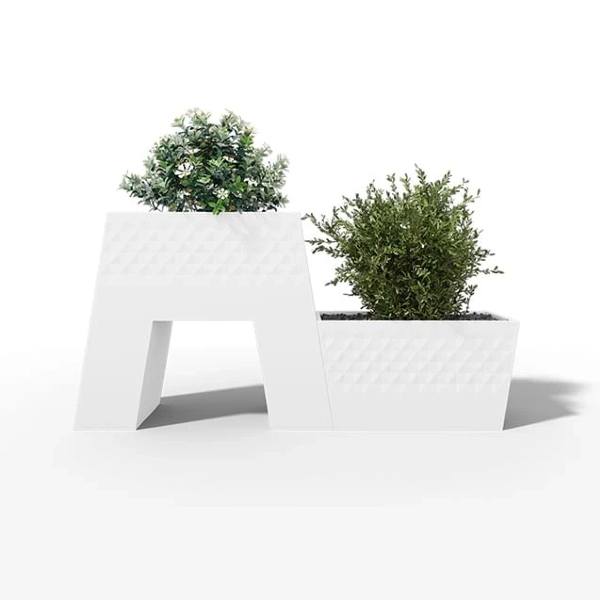
If one planter type represents commercial flexibility best, it is the modular planter. Modular systems are valuable because they allow one planter concept to shape a whole zone. Instead of relying on one oversized unit, businesses can create longer runs, repeated arrangements, or layouts that fit the room more naturally.
This matters in open-plan interiors where a planter needs to do more than decorate. In offices, modular runs can divide collaborative and quiet zones without hard barriers. In cafés and lounge areas, they can frame seating while maintaining openness. In retail, they can guide the layout without making the floor feel too segmented.
Another reason modular planters rank highly is that they support consistency. Many commercial projects extend across departments, branches, or rollout programs. A modular system makes it easier to repeat the same visual standard while adjusting the arrangement for different footprints.
Some spaces need a planting solution that can define an area rather than simply decorate one point. Modular runs work especially well here. A continuous or semi-continuous arrangement can guide movement, support privacy, and create a cleaner edge around a lounge, café, or shared office zone.
This is particularly useful in open-plan workplaces where a built divider may feel too heavy. Modular planters offer a softer solution. They help separate functions while keeping the room visually connected. In hospitality spaces, they can shape seating clusters without closing them off.
Consistency matters in commercial branding. When a company has several branches, hospitality sites, or retail units, repeatable planter modules help create a more unified interior language. Even when layouts differ, modular systems make it easier to keep the same overall look.
This helps not only with visual identity but also with operations. Standardized planter modules simplify ordering, maintenance planning, and future expansion. That repeatability is one of the biggest reasons modular planters deserve a high place on this list.
Not every commercial planting choice needs to be large. Tabletop planters have an important role in interiors where small-scale greenery can add polish without changing the layout. Reception desks, shelving units, display ledges, café counters, and meeting room storage surfaces often benefit from this type of detail.
Their strength is control. They allow greenery to appear where space is limited and where the planter must stay secondary to another function. On a reception desk, that means adding warmth without blocking sightlines. On a shelf, it means introducing texture without clutter.
These planters work best when scale is handled carefully. Too small, and they feel unimportant. Too large, and they interfere with the surface they are meant to complement.
Statement planters sit at the opposite end of the scale from tabletop styles, but they serve an equally important purpose. In hotel entries, showroom fronts, and major reception zones, large statement planters can establish atmosphere immediately. They create visual confidence, support larger plant pairings, and help define the first impression of the space.
The key is not simply size. A statement planter needs proportion, durability, and enough practicality to remain usable in a changing commercial environment. Large planters often need to be repositioned for seasonal updates, event layouts, or refreshed displays. That is why lightweight but strong material performance matters so much here.
Statement planters are often most effective when used with restraint. One or two well-placed pieces can do more than a row of oversized forms without clear purpose. In hotel settings, they can frame the entrance or anchor a feature wall. In showrooms, they can strengthen presentation while making the space feel more complete.
The phrase top indoor planters only becomes useful when it is sorted by use case. A planter that works beautifully in a corridor may not be the right choice for a lounge, and a reception desk planter should not be judged by the same standard as a hotel entry feature. That is why the smartest commercial decisions focus on where the planter will be used, how it needs to perform, and what kind of layout it needs to support. Rovis develops planter solutions with that practical approach in mind, helping interiors stay functional, attractive, and easier to maintain. If you are planning a lobby, office, or retail project, contact us to find the right commercial indoor planters for your space.
Tall rectangular planters and statement planters are often strong choices for lobbies because they create presence, help organize open space, and support a strong first impression.
Modular planters help shape larger zones, divide open areas, and maintain visual consistency across different layouts. They are especially useful in offices, cafés, and branded retail interiors.
They often are. Round planters bring a softer look that works well in reception lounges, waiting areas, and hospitality spaces where comfort and atmosphere matter.
Tabletop planters are a good choice for reception desks, shelves, counters, and meeting room surfaces where greenery is needed in a smaller, more controlled way.


