
English 
T: +86-139-2641-8287
No.51, Chuangye Road, Taiping Town, Conghua District, Guangzhou City, Guangdong Province, China


Views: 0 Author: Site Editor Publish Time: 2026-04-10 Origin: Site


A busy lobby quickly reveals whether a planting setup truly works. Staff notice what is hard to clean, visitors notice what feels out of place, and facility teams notice what leaks, chips, or blocks the flow of the room. That is why Indoor Planters in commercial spaces need to do far more than hold greenery. They must fit the layout, stay presentable, support daily traffic, and remain easy to manage over time. Rovis, a Chinese supplier with deep experience in composite materials and large-scale production, understands that real value comes from performance in use, not appearance alone. In high-traffic interiors, the best planter is the one that keeps doing its job long after installation.
The first question is not color or finish. It is what the planter needs to accomplish in the space. In commercial interiors, planters often serve a practical role. They may guide movement, define a seating area, soften an empty corner, create privacy, or make a large room feel more structured.
That role changes from zone to zone. A planter near a reception desk should add warmth without crowding the work surface. One in a hotel entrance should create presence immediately. A planter in a corridor should introduce greenery without narrowing the path. In retail, planters can shape traffic flow and reduce the visual pressure of a busy floor. Once the purpose is clear, the rest of the selection becomes much easier.
This is why good projects think about planters early. When planters are added at the very end, they are often too large, too fragile, or too awkward for the space. When they are treated as part of the layout, they improve both function and appearance.
Entrance areas need visual impact, but they also need stability and durability. A planter near the front of a building may sit beside doors, luggage, carts, cleaning equipment, and constant foot traffic. If it is heavy and brittle, installation becomes difficult and later movement becomes risky. If it is too small or visually weak, it disappears.
The best solution is a planter that feels substantial without becoming a burden to transport or reposition. This matters even more in commercial spaces that update seasonal displays or rearrange furniture from time to time. A planter that can move more easily while still looking premium is far more useful over the long term.
It also protects first impressions. A chipped planter or a stained base near the entrance affects how the whole interior feels. Busy spaces need products that stay composed under everyday pressure, not only in a showroom photo.
Open interiors often look clean in design drawings but feel exposed in real use. Shared spaces usually work better when planters take on more than one role. A planter can divide a waiting zone from a circulation path, frame a lounge area, guide people through a corridor, or add privacy to a semi-open corner.
That is where commercial indoor planters show their value. They do not just fill empty space. They help organize it. In a lounge, a planter can make the seating feel finished. In an office, it can soften the boundary between collaborative and quiet zones. In retail, it can create structure without the heaviness of fixed partitions.
This is especially useful in interiors that need flexibility. A planter is easier to reposition than a wall or built divider, yet it still helps shape how the room functions. When selected well, it supports both daily use and visual order.
Shape affects performance more than many people expect. The right shape helps the layout feel natural, while the wrong one can interrupt movement, complicate cleaning, or look out of scale. In busy interiors, practical fit matters more than style language.
Long rectangular planters work well when the goal is to define edges or create a soft divider. Cube planters suit corners, columns, and seating zones because they feel compact and balanced. Round planters help soften rigid interiors and often fit hospitality spaces well. Tabletop planters are useful when a reception desk, shelf, or display area needs greenery without losing too much surface space.
Each shape solves a different problem. Looking at the room that way usually leads to better choices than simply following a trend.
Corridors and transition zones usually need planters with a smaller footprint. Tall, narrow forms are effective because they use height instead of width. That keeps walkways open while still adding greenery and vertical presence.
These forms also work well in repeated placement. A row of slim planters along a corridor can create rhythm and order without making the space feel crowded. In office interiors, they are useful near walls, elevator areas, and underused corners where broader planters would feel intrusive.
When paired with upright foliage, tall planters bring freshness without demanding much floor area. That makes them one of the most reliable options for tighter commercial layouts.
Lounges and waiting areas usually benefit from a calmer look. Lower planters and softer forms support that atmosphere. They feel less formal, sit more naturally around seating, and reduce the visual hardness of rooms filled with straight lines and polished surfaces.
This matters in places where people sit and take in the environment. A planter that feels too rigid can make the room seem more formal than intended. Round or low-profile forms usually create a more relaxed impression while still keeping the space polished.
Space Zone | Best Planter Shape | Best Plant Style | Why It Works |
Main entrance | Tall rectangular | Upright foliage | Creates presence and frames the entry |
Reception desk | Tabletop or compact cube | Small leafy plants | Adds warmth without crowding the counter |
Corridor | Tall narrow planter | Vertical greenery | Keeps walkways open while adding height |
Waiting lounge | Round or low-profile planter | Fuller soft-form plants | Supports a calmer atmosphere |
Retail divider | Long rectangular or modular planter | Medium-height repeated plants | Defines areas and guides movement |
Corner display area | Cube planter | Statement foliage plant | Finishes empty corners neatly |
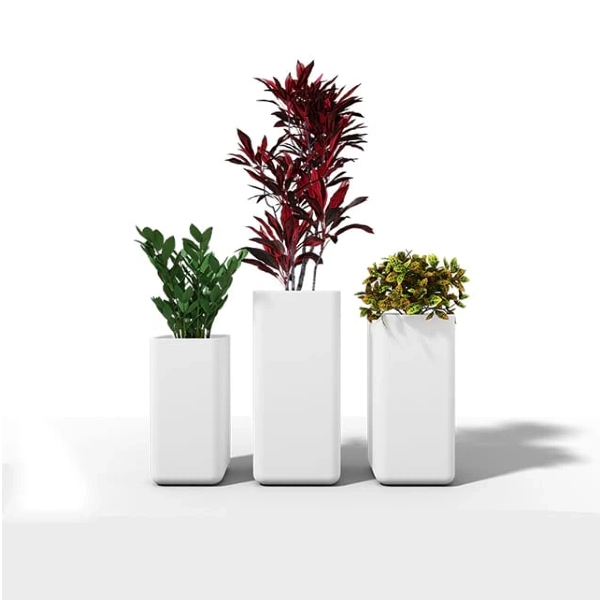
Water management is one of the most important parts of indoor planting. A planter may look excellent at first, but if it causes stains, drips, or awkward maintenance, it quickly becomes a problem. Indoors, water affects more than the plant. It affects floors, furniture, cleaning routines, and the overall appearance of the space.
This is why planter design should support controlled indoor use from the beginning. Waterproof bodies, drainage flexibility, and clean containment all contribute to a better result. In offices, hotels, showrooms, and retail stores, the planter should make greenery easier to manage, not harder.
Different planting programs need different watering approaches. Some projects use direct planting, while others prefer drop-in pots for easier replacement and seasonal updates. Some plants need tighter water control, while others are more forgiving. Adjustable drainage makes sense because it gives the planter more flexibility across different project needs.
This is especially helpful when one site includes several zones. A reception area, meeting room, and lounge corner may all need different handling. A planter that can adapt to those differences helps keep the project more consistent without forcing every space into the same setup.
Hidden trays solve two problems at once. They help contain excess water, and they keep the planting display looking cleaner. Visible saucers may be acceptable in casual settings, but they often look unfinished in polished commercial interiors. A hidden tray protects the floor while preserving a more complete appearance.
That matters because interior damage does not need to be dramatic to be costly. Small water marks near a front desk or on a showroom floor can weaken the impression of the whole space. Cleaner water control supports both maintenance efficiency and presentation.
Busy interiors are hard on surfaces. Dust, fingerprints, shoe marks, cleaning products, and daily contact all leave traces over time. A planter finish that is easy to wipe clean and resistant to visible staining will always be more useful in commercial settings than one chosen only for first impression.
Hotels, office buildings, retail stores, and public lounges all need finishes that can keep up with regular use. The goal is not perfection. The goal is to keep a neat, professional appearance without constant extra work. That is where stain-resistant surfaces and durable material performance become genuine advantages.
Finish also affects how well the planter supports the design of the space. Neutral tones work across many interiors, while custom colors can reinforce brand identity. Texture matters too. Some surfaces hide light wear better, while others support a sharper architectural look. The best finish is the one that still looks right after months of use.
For businesses with multiple locations, finish consistency is another advantage. A stable color and texture system makes it easier to maintain the same visual standard from one site to another and simplifies repeat orders.
A planter program only succeeds if it stays manageable after installation. In busy commercial spaces, planters are cleaned around, replanted, moved for events, and sometimes relocated during layout changes. Maintenance is not a side issue. It is part of daily operation.
That is why it is important to think beyond delivery day. A planter that looks attractive at first but becomes inconvenient to move or maintain will create unnecessary work later. Over time, that affects labor, consistency, and the overall quality of the planting display.
Commercial spaces also change regularly. A lobby may need seasonal updates. A retail floor may adjust customer flow. A hospitality venue may rework part of the layout for an event. Planters that adapt to those changes keep their value much better than products chosen only for appearance.
Weight still matters after shipping is over. A lighter planter is easier to position, easier to move during cleaning, and easier to relocate when the layout changes. In commercial interiors, those practical benefits add up quickly.
Of course, lightweight only helps if the planter is also durable. Busy spaces need planters that are easy to handle without feeling weak or temporary. That balance is one of the biggest strengths of engineered composite materials. They allow planters to stay practical while still meeting the visual expectations of modern commercial projects.
Rovis has built its manufacturing strength around composite material development and production, giving customers planter solutions that are easier to install, easier to maintain, and better suited to demanding interiors. For projects where water resistance, durability, easy cleaning, and manageable weight all matter at once, that combination offers clear long-term value.
What makes a planter work in a busy space is not one feature alone. It is the way shape, water control, surface finish, and everyday usability come together to support the room. When these details are handled well, greenery becomes easier to maintain and more effective in the overall design. That is why well-made planter solutions matter in offices, hotels, lobbies, and retail interiors. Rovis supplies products built for this kind of real-world use, helping commercial projects stay attractive and easier to manage over time. If you are planning an interior greenery project, contact us to learn more about the right commercial indoor planters for your space.
A busy lobby usually needs a planter that looks substantial, resists daily impact, and remains easy to clean. Tall rectangular planters are often a strong choice because they create presence without taking up too much floor area.
Narrow planters help keep walkways open while still adding greenery and height. They are a practical option for office corridors, elevator areas, and other transition zones where floor space is limited.
Hidden trays are highly useful in commercial interiors because they help contain excess water and keep the display looking cleaner. They also reduce the risk of marks on floors and nearby surfaces.
Lightweight planters are easier to move during cleaning, seasonal updates, and layout changes. That makes them more practical for commercial spaces where flexibility and maintenance efficiency matter.


