
English 
T: +86-139-2641-8287
No.51, Chuangye Road, Taiping Town, Conghua District, Guangzhou City, Guangdong Province, China


Views: 0 Author: Site Editor Publish Time: 2026-04-21 Origin: Site


Ceramic can look refined, but it may crack during transport or replacement. Plastic is easy to move, yet it often lacks the visual quality many commercial projects expect. Concrete feels solid, but it can be difficult to install, reposition, and manage indoors. That is why better Indoor Planters matter so much in commercial interiors. The strongest option is not the one that performs well in only one area. It is the one that solves several problems at once. Rovis, with nearly 20 years of experience in composite materials and large-scale production, understands that commercial buyers are comparing far more than appearance. They are also looking at weight, strength, waterproofing, maintenance, and long-term usability.
Material affects far more than the look of a planter. It shapes the full experience from delivery to installation to daily use. In commercial interiors, that experience directly affects labor, maintenance, risk control, and how confidently a team can place the planter across different parts of a project.
A heavy planter may seem impressive at first, but that weight can create problems before the planter even reaches its final position. Freight becomes harder, installers need more effort to place it, and later movement becomes less practical. A fragile material creates another issue. Even if it looks attractive, it may chip or crack too easily in a public setting. A material that looks inexpensive may solve one problem but weaken the visual standard of the space.
That is why material choice should never be treated as a small detail. It influences how the planter feels in the room, how it performs around daily traffic, and how much work it creates later. In commercial interiors, a strong material is one that supports design, handling, and reliability at the same time.
This becomes even more important in larger projects. A product used in one reception area may later be specified for corridors, lounges, meeting zones, or multiple locations. When the material performs consistently across those conditions, the whole project becomes easier to manage.
Weight may look minor on paper, but in commercial interiors it quickly becomes a major issue. A lighter planter is easier to ship, easier to carry, easier to install, and easier to move again when layouts change. That makes a real difference on projects where time, labor, and access all matter.
The effect begins before installation. Lower weight can reduce delivery risk and simplify handling on site. It becomes important again during placement, especially in upper-floor interiors, tight entrances, elevator access points, and areas where several planters are being installed at once. Later, it matters when cleaners work around the planter, when seasonal displays change, or when a space needs to be refreshed.
Weight also affects confidence. Teams are more likely to reposition and reuse a planter when it feels manageable. A planter that is too heavy often stays where it was first placed, even when the layout would benefit from an update. In that sense, lighter weight supports flexibility as much as convenience.
Material | Weight | Indoor Durability | Water Control | Maintenance Level |
Ceramic | Heavy | Can chip or crack | Depends on construction | Moderate to high |
Plastic | Light | May scratch or wear quickly | Varies widely | Low to moderate |
Concrete | Very heavy | Strong but difficult to handle | Usually stable but bulky | Moderate |
Composite polyurethane | Light | Strong and impact-resistant | Excellent for indoor use | Low |
A lighter planter also reduces pressure on the wider project. Easier installation means less time spent on positioning and adjustment. Better mobility means the planter remains useful when the space changes. In commercial work, those practical advantages add up quickly.
What matters most is that lightweight should not mean weak. A better planter combines easier handling with a surface and structure that still look dependable in a demanding interior. That balance is one of the clearest reasons advanced composite materials are so relevant in commercial planter design.
Commercial interiors do not stay untouched for long. Planters may be bumped by cleaning carts, brushed by luggage, touched by passing traffic, or shifted during routine maintenance. This constant public use is why strength matters so much indoors. A planter has to keep its appearance while living in a real environment, not only in a styled photo.
Durability is not only about preventing serious damage. It is also about resisting the smaller signs of wear that make a product look tired too soon. Dents, surface marks, chips, and uneven edges all reduce the quality of the interior. In a lobby, showroom, office corridor, or retail setting, those details are noticed more than many buyers expect.
A strong planter helps maintain the standard of the space. It keeps the greenery looking intentional and helps the area stay polished with less effort. This is especially important where planters are part of a first impression. A worn planter near an entrance or reception desk affects the whole room, not just the product itself.
Commercial projects rarely want planters that feel rough or visually heavy. What they need is toughness that still looks refined. Some materials feel durable but are too bulky. Others look clean and premium but are too easy to chip or mark.
A better indoor planter should resist everyday impact without losing its shape, finish, or visual appeal. That is particularly useful in hospitality projects, retail spaces, office buildings, and other interiors where people move quickly and equipment is always in use. The planter needs to hold up, but it also needs to continue supporting the design language of the room.
A planter that survives public use but looks too heavy may not suit the interior. A planter that looks elegant but fails under daily pressure will create replacement costs and visual inconsistency. The best option does not force a choice between the two.
Indoor use does not remove the need for temperature stability. Commercial interiors may seem controlled, but real conditions vary more than many people expect. Storage areas, loading points, atriums, window zones, covered entrances, and sunlit corners can all expose planters to changing temperatures over time.
Transport adds another factor. A planter may move through very different conditions before it reaches the final interior. Seasonal delivery, warehousing, and installation timing can all affect material performance. A planter that handles those transitions well gives buyers more confidence from the start.
Temperature stability is also useful in mixed-use environments where indoor and semi-indoor conditions overlap. A planter placed near glass walls, close to heating or cooling flows, or in bright reception zones needs material performance that stays reliable rather than becoming brittle, warped, or unstable.
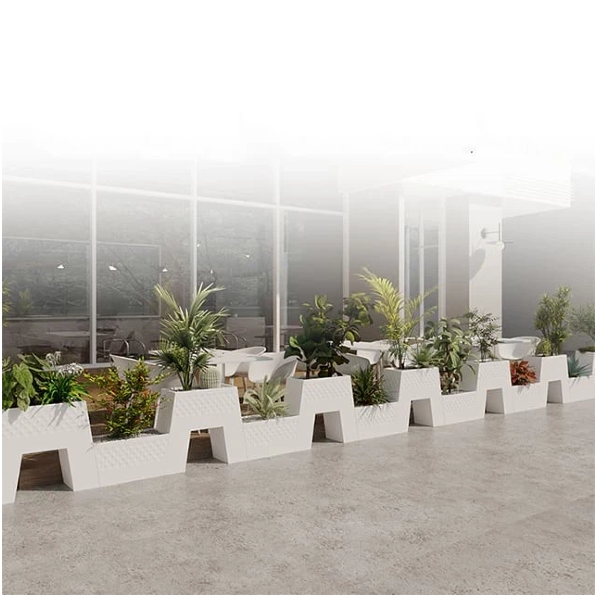
Water management is one of the clearest differences between residential and commercial planter requirements. Indoors, the planter does not only need to support healthy plants. It also needs to protect the surrounding space. That means floors, rugs, counters, furniture, display areas, and all the surfaces that make up the environment around it.
This is why indoor-specific water control matters so much. A planter that leaks slightly, traps water in the wrong place, or makes watering awkward can quickly become a maintenance problem. In a commercial interior, even a small stain can affect the overall impression of the space. The more visible and carefully finished the environment is, the more important water control becomes.
A better indoor planter handles water in a way that feels clean, reliable, and easy to manage. That makes plant care simpler while protecting the investment around the planter itself.
A waterproof planter body is not just a technical feature. It is a practical safeguard for indoor spaces. Wood flooring, tile joints, rugs, counters, and nearby furniture all benefit when moisture stays under control. This is especially important in reception areas, lounges, and retail interiors where presentation is always on display.
Leaks and seepage do not need to be dramatic to cause problems. Repeated light moisture can still leave marks, weaken finishes, or create cleaning issues over time. A waterproof body reduces that risk and helps make the planting program more dependable.
For facility teams, this also brings peace of mind. The planter becomes easier to trust in visible areas because it is less likely to create hidden problems. In busy interiors, that confidence matters almost as much as appearance.
Good water control should not interrupt the visual quality of the planter display. Hidden trays are valuable because they contain excess water while keeping the overall look cleaner and more finished. Visible saucers may work in casual spaces, but they often feel out of place in polished commercial interiors.
A concealed tray supports both function and presentation. It protects the surface below, reduces visible mess, and helps the planter feel more integrated into the room. This is especially useful in entrances, offices, showrooms, and hospitality spaces where details matter.
Commercial interiors often need more than one planter size, one color, or one exact layout. They need flexibility. A reception zone may require a statement planter, while a corridor needs a slimmer format and a seating area may need a softer shape. If the material and finish options are too limited, it becomes harder to build a consistent result across the project.
This is where design flexibility adds real value. Color matching helps planters align with brand identity or interior palette. Texture variety allows the planter to suit different architectural styles. Custom sizing makes it easier to solve specific layout needs without forcing the room to adapt to a standard product that does not quite fit. Modular options bring even more control by allowing several planters to work together across larger spaces.
This kind of flexibility is especially useful for chains, office groups, hotel programs, and other projects where visual consistency matters across more than one site. A planter system that can stay recognizable while adapting to different footprints makes the whole specification process stronger.
Upfront price is only one part of planter value. Commercial buyers also need to think about service life, replacement frequency, maintenance effort, transport risk, and how well the planter will continue to represent the space after months or years of use. A cheaper planter may stop looking like a bargain once those factors begin to add up.
Longer service life changes the budget conversation because it shifts attention from purchase price to total value. A planter that resists dents, stays presentable, manages water safely, and avoids frequent replacement often costs less in the long run even if the initial price is higher. It also supports more consistent interiors because fewer pieces need to be swapped out early.
Rovis approaches planter development with that broader commercial view. Stronger materials, lighter handling, controlled water management, finish flexibility, and longer-lasting use all contribute to a product that supports the space beyond the opening phase. That is what makes a planter feel like part of a durable solution rather than a temporary visual layer.
A better indoor planter should not force a compromise between appearance, maintenance, and durability. For commercial interiors, the right option supports all three. It should be light enough to handle, strong enough for public use, safe enough for indoor water control, flexible enough for branded spaces, and durable enough to justify its long-term value. That is what separates an ordinary planter from a smarter interior solution. Rovis develops products with exactly that balance in mind, helping projects stay cleaner, more efficient, and more consistent over time. If you are planning your next interior project, contact us to learn more about the right commercial indoor planters for your space.
Material affects shipping, installation, strength, maintenance, appearance, and water control. In commercial interiors, it shapes the whole user experience, not just the look of the planter.
A lighter planter is easier to deliver, install, reposition, and clean around. That reduces labor pressure and makes future layout changes much easier.
Yes. Waterproof construction helps reduce the risk of stains, leaks, and moisture damage on floors, rugs, counters, and nearby furniture. That is especially important in visible commercial settings.
A longer-lasting planter can reduce replacement frequency, maintenance effort, and transport-related damage costs. Over time, that often makes it a better investment than a lower-cost option with a shorter useful life.


